
Is a HELOC Right For You?
Key Takeaways
- A HELOC lets you borrow money using your home as security.
- You can borrow what you need, up to your approved limit.
- Interest rates can change, which means your payments may go up.
- Some HELOCs require one large payment at the end.
- If you can't repay what you borrow, you could lose your home.
- A HELOC works best when you have a clear plan to use and repay the money.
If you’ve owned your home for a while, it may be worth more than you still owe on your mortgage. That difference is called home equity.
A home equity line of credit (HELOC) lets you borrow money using the equity in your home. It can help you pay for home repairs, improvements or other large expenses.
But a HELOC comes with risks. Before you borrow, it’s important to understand how it works and how you’ll pay it back.
How Does a HELOC Work?
A HELOC works a lot like a credit card. You get a set borrowing limit and use the money when you need it.
The big difference is that your home is used to secure the loan.
HELOCs generally have two stages:
Borrowing stage: You can take out money, pay it back and borrow again. Some HELOCs only require you to pay interest during this time.
Repayment stage: You must pay back what you borrowed. Depending on your loan terms, you may make monthly payments or owe one large final payment.
Your monthly payment depends on how much you borrow, your interest rate and how your HELOC is set up.
What Are the Benefits of a HELOC?
A HELOC may be helpful for several reasons.
Borrow only what you need. You don't have to take out the full amount at once. This can help when you're paying for a project in stages.
Potentially lower interest rates. HELOCs often have lower rates than credit cards or personal loans.
Keep your current mortgage. A HELOC is separate from your first mortgage, so you don't have to replace your existing mortgage.
Possible tax benefits. Interest may be tax-deductible if you use the money for certain home improvements. Check with a tax professional.
What Are the Risks of a HELOC?
Before opening a HELOC, think about these possible costs and risks.
Your payment could increase. Most HELOCs have changing interest rates. If rates rise, your payment may rise too.
You could lose your home. If you can't make your payments, your lender could take your home.
You may owe a large final payment. Some HELOCs require you to pay the remaining balance all at once when the loan ends.
There may be extra fees. Ask about closing costs, annual fees and other charges before you borrow.
When Might a HELOC Make Sense?
A HELOC may be a good choice if you have steady income and a plan to repay what you borrow.
Here are some common uses:
Home improvements: Paying for a new roof, kitchen remodel or major repairs.
Paying off higher-interest debt: Combining debts into one loan may lower your interest costs. But remember, you're putting your home at risk and you'll need to avoid building up new debt.
Expenses spread over time: Paying for projects or other planned costs in stages.
Example: Paying for a Kitchen Remodel
John and Jane want to update their kitchen.
Their home is worth $260,000 and they still owe $140,000 on their mortgage.
Based on their home's value and their lender's rules, they may qualify to borrow up to $81,000.
They open a $60,000 HELOC but only borrow $40,000 for their kitchen.
Let's look at what happens if they make only the minimum interest payments.
Illustrative example of the same HELOC without additional monthly payments.
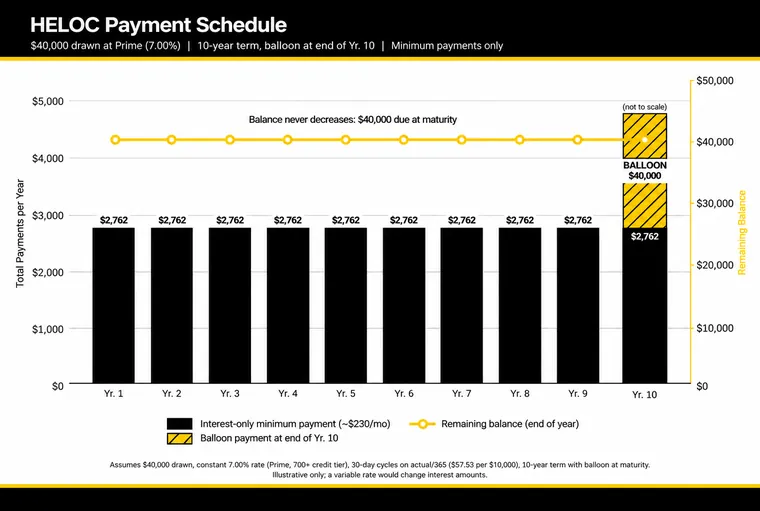
HELOC payment example: $40,000 borrowed at a 7% interest rate over 10 years, with interest-only payments and a $40,000 final payment.
What Does This Mean for You?
In this example, John and Jane pay about $230 a month in interest.
But those payments don't reduce what they owe.
After 10 years, they still owe the full $40,000. They must pay that amount all at once when their HELOC ends.
If their interest rate goes up during those 10 years, their monthly payments could increase too.
The lesson: A low monthly payment doesn't always mean a lower total cost. It's important to plan for paying back the full amount, not just the interest.
This example assumes a 7% interest rate that stays the same. Actual HELOC rates and payments may change.
When Might a HELOC Not Be Right for You?
A HELOC isn't the best choice for everyone.
You may want to consider other options if:
- Your income changes often. It could be harder to make payments during slower months.
- You need money for everyday bills. Using your home equity for groceries, vacations or regular expenses can create more debt.
- You plan to sell your home soon. You'll need to pay off your HELOC when you sell.
- You want a payment that stays the same. A fixed-rate home equity loan may be a better choice.
The Bottom Line: Is a HELOC Right for You?
A HELOC can help you pay for home improvements or other planned expenses without borrowing all the money at once.
But it also puts your home at risk, and your payments may change.
Before deciding, ask yourself:
- How much do I really need to borrow?
- Can I afford the payments if rates go up?
- How will I pay back the full amount?
- Is there another option that better fits my needs?
You don't have to figure it out alone. First Financial Bank can help you explore your options and understand what may work for your goals.